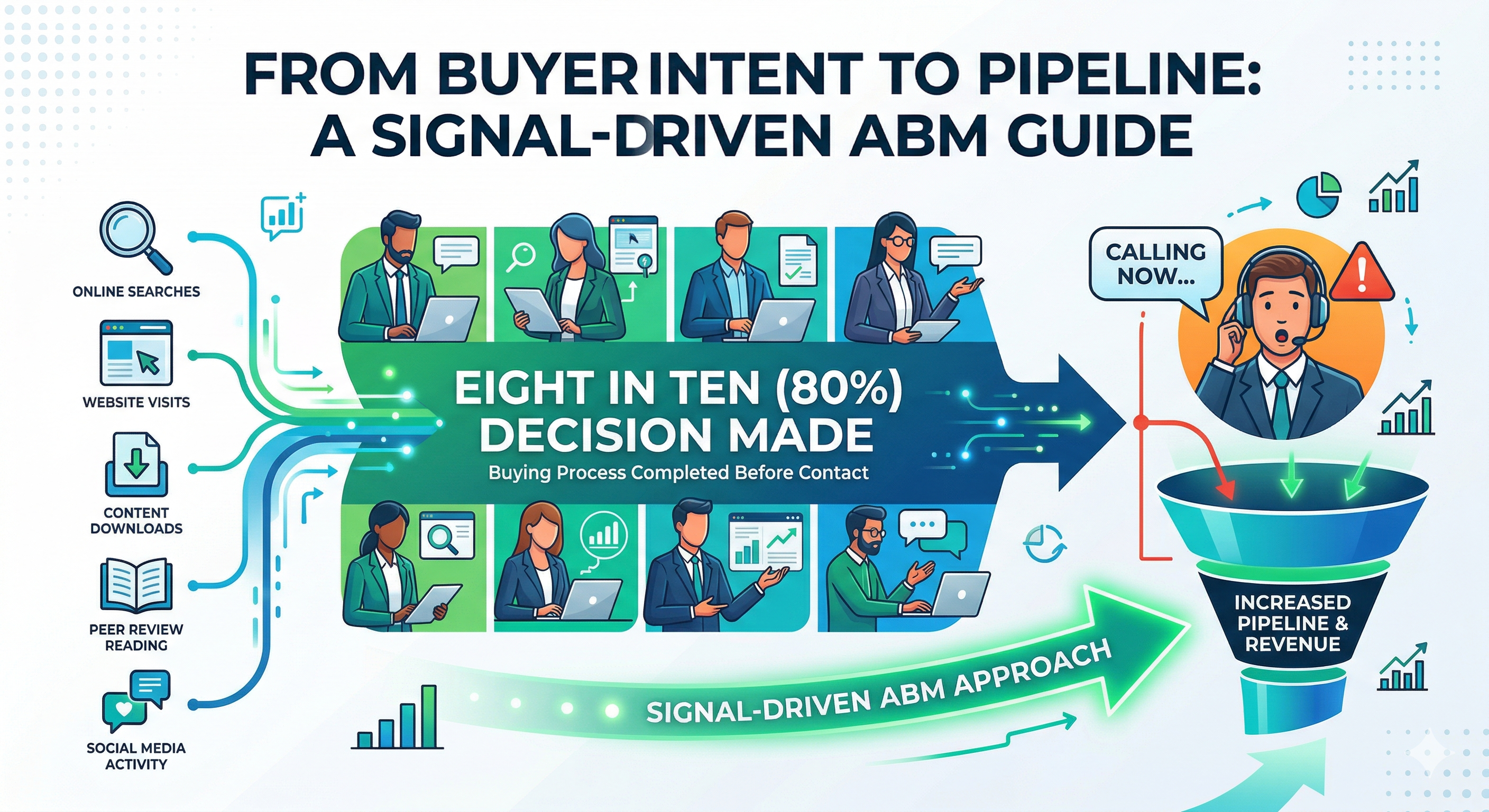

Sit with that for a second.
When a prospect finally appears in your pipeline, when they fill out a form, reply to an outreach email, or agree to a discovery call, there's an 81% chance they've already decided who they're going to buy from. They've done the research, compared the options, and formed a view. They're talking to you because due diligence requires it, or because their preferred vendor is taking too long to respond, or because their boss asked them to get three quotes.
This isn't pessimism. It's what 6sense found when they studied how B2B buying decisions actually get made. Buyers are nearly 70% through the process before they engage a seller.
Which raises an obvious and uncomfortable question: if most of the decision happens before first contact, what exactly is your current go-to-market strategy designed to influence?
The gap most revenue teams don't want to look at directly
We work with many B2B teams within HubSpot. Smart people, good products, genuine investment in sales and marketing. And almost without exception, they're running some version of the same programme: define the ICP, build the list, run campaigns, wait for inbound, chase the leads that come in.
It works. Partially. Inconsistently. And increasingly less well than it used to.
Here's what's actually happening in the background while that programme runs. A company that fits your ICP perfectly; the right industry, the right size, the right tech stack- starts researching your category. They're not ready to talk to anyone yet. They're building internal consensus, mapping out requirements, and figuring out what a solution even needs to look like. They spend six weeks doing this research entirely off your radar.
Then they visit your website. Three people from the same business, across four sessions, over ten days. They read your pricing page twice. They download a case study. They compare you to a competitor on a review site.
And then they go quiet.
Two months later, one of your SDRs cold-calls their Head of Operations and gets told they "evaluated something similar last year and went a different direction."
They didn't go in a different direction. They went with someone else while you weren't watching.
The buying signal was there. You just couldn't see it.
This is the problem buyer intent data solves, and it's worth being precise about what that actually means in practice, because "intent data" has become one of those phrases that gets used to mean almost anything.
In HubSpot, it works across three distinct layers, each catching a different part of the buying journey.
The first is your own website. IP-matching identifies which companies are visiting, even when nobody fills out a form, and 98% of your visitors never will. You can see which pages they're spending time on, how often they're returning, and whether multiple people from the same organisation are sharing the same window. That last one matters more than most teams realise, which we'll come back to.
The second is off-site research behaviour. HubSpot monitors content consumption across the B2B web against a set of keyword topics you configure. When a company's research activity spikes significantly above its historical baseline, it's a reliable early signal that an active buying cycle has started, often three to six months before it reaches out to a vendor. This is the layer that gives you a genuine early-mover advantage.
The third is company news. Funding rounds. Senior hires. Market expansion. These are buying triggers, not just interesting updates. A business that closed a Series B last month has a mandate to invest that didn't exist before. A new CRO isn't inheriting a sales tech stack they had no say in building. These events open outreach windows that close faster than most teams move.
If you're sitting on intent data you're not acting on - this is for you.
We put together a complete implementation guide that covers everything: how to configure all three signal types in HubSpot, how to build the scoring model that prioritises which accounts to act on first, and the four automated workflows that turn signals into a pipeline without manual triage.
It's free. It's practical. And if buyer intent is something you've looked at but haven't yet built into a proper system, it's the implementation bridge you need.
Download: From Buyer Intent to Pipeline - A Signal-Driven ABM Guide →
Intent is only half of it. The other half is knowing what to do when it fires.
Knowing a company is in-market is genuinely valuable. But it creates a new problem: which accounts do you focus on, and how much effort does each of them deserve?
This is where most intent programmes run into trouble. Teams see signals, try to action all of them, and either overwhelm their SDRs or spread effort so thin that nothing is done particularly well. What you need is a clear model for matching your response to the signal's strength.
The framework that works runs three motions simultaneously.
For accounts showing the strongest signals, Research Intent surging more than 160% above baseline, multiple people from the same company hitting your pricing and demo pages, a funding announcement just dropped, these get your full Tier 1 treatment. The AE is directly involved. Everything is personalised to that specific account. You respond within four hours. At any given time, you should have 10–20 accounts in this tier. No more. The whole point is concentrated effort.
For accounts showing moderate signals, active research interest, some engagement, and the right profile, you cluster them by shared industry or problem and run a coordinated SDR-led play. Personalised at the cluster level, not the individual level, but specific enough to feel genuinely relevant rather than templated.
For everyone else on your ICP list who hasn't shown meaningful intent yet, you run lightweight automated awareness. Low-frequency ads. Educational sequences. You're not trying to convert anyone here; you're making sure that when their window does open, you're already a familiar name.
And as signals strengthen, accounts move up automatically. A Tier 3 company that suddenly starts hitting your pricing page daily and spikes on Research Intent doesn't wait for your next quarterly planning cycle. The system catches it and escalates in real time.
The signal almost no one is watching - and why it matters
Here's something we've seen consistently that rarely makes it into conversations about intent data.
When three or more people from the same company become active within a seven-day window, visiting your site, engaging emails, clicking through to content, that's not a coincidence. That's a buying committee that has assembled internally. Someone has put your name on an evaluation list and circulated it to colleagues.
Most CRM setups miss this completely because they track contacts as individuals rather than as a coordinated group at the company level. But if you build a workflow that watches for this pattern, you start catching evaluations that would otherwise sail past entirely.
When this fires, treat it as your highest-priority trigger. The committee is already meeting. Don't wait for more evidence.
On speed: the uncomfortable maths
McKinsey's research found that 78% of buyers choose the first vendor to respond in a meaningful, relevant way.
Not the cheapest. Not the one with the best feature set. The fastest, relative to when the buying signal went live, and the window was open.
Every hour between a HIGH intent signal firing and your AE making contact is an hour a competitor might be filling. We've seen this play out enough times with clients to say with confidence: the conversion difference between Tier 1 accounts contacted within four hours versus those that slipped to 48 hours is not marginal. It's significant. And it's almost entirely a process problem, not a messaging problem.
The technology to automate the alert, create the deal record, brief the AE, and track the SLA exists inside HubSpot today. The harder part is building the operational discipline to honour the response time when an AE is busy, and the account hasn't explicitly raised their hand yet.
It's worth building. The data from teams who've done it makes the case plainly.
The content gap that quietly kills Tier 1 deals
There's one more thing worth naming before you go and build all of this.
Most content libraries are built for Tier 3. Blog posts, general case studies, thought leadership, and content designed to attract and educate a broad audience. It's valuable at the top of the funnel. It's the wrong tool when you're trying to win a deal that's already in motion.
A Tier 1 account in active evaluation doesn't need another industry insight piece. They need to see a case study from a company that looks exactly like them. They need an ROI model built with their numbers. They need an email from an AE who has clearly done some research, not something that arrived because a workflow triggered it.
One of our clients described the goal well: you want the prospect to read the first sentence and think, "how did they know?" That's the level of personalisation that shifts a shortlist. And it requires marketing and sales to operate from the same account plan, not running parallel, disconnected programmes.
This is solvable. But it needs to be designed deliberately, not bolted on after the intent infrastructure is already live.
The complete playbook - free to download
We've taken everything above and turned it into a step-by-step implementation guide you can work through inside HubSpot.
It covers the full setup for all three signal types, the Company Lead Score model with specific point values for each signal, four workflow blueprints (Tier 3 nurture, Tier 2 cluster play, Tier 1 full account play, and tier graduation logic), the Rules of Engagement template for aligning sales and marketing, and a 30-day launch plan with a week-by-week checklist.
If you've read this far, you're probably already aware your team is leaving something on the table. The guide is the practical next step.
Download: From Buyer Intent to Pipeline - A Signal-Driven ABM Guide →
The companies pulling ahead right now aren't doing something dramatically different in terms of product or headcount. They've just built a system that finds the 2–5% of their market that's actively buying, engages them before the shortlist closes, and responds to signals faster than competitors who are still waiting for the form to be filled out.
That system is buildable. In HubSpot. In 30 days.
The guide shows you exactly how.
Talk to an Expert
If you’d like to talk to our experts about how to optimise your data structure, book a call—we promise not to judge your current property count.



.png?width=50)

%20(1).jpg?width=50)
.png?width=50)

.png?width=50)
.png?width=50)


