.png?width=1748&height=1240&name=BQ%20Blog%20hero%20(2).png "BQ Blog hero (2)")

Following on from our recent research into the admissions crisis in Higher Education we anticipated - correctly as it turns out - that our University contacts would have a lot more questions, so we collated findings from multiple other industry reports, asked our clients about their previous experiences, and spoke with many other notable people from the sector at recent education events, to explore their challenges of implementing CRMs.
Before we go into the new findings, here are 3 from the original report:
- 77% of higher education leaders agree that CRMs help to improve student admissions Key Performance Indicators (KPIs).
- 53% of respondents estimated that running their admissions process without a CRM or automation tools would require up to five additional full-time staff to maintain current performance. The total cost of that is likely to be multiple times higher than running a successful CRM system.
- 61% of universities that have implemented a CRM system have experienced at least one failed project. The top reason stated? Not the technology. Not the budget. User adoption. Put simply - “We built it, they didn’t use it.”
What we’ve found from our follow up research, are some numbers that could explain why Universities find it so hard to sign off on this kind of digital transformation:
- These projects are large. The average cost savings anticipated from implementing a University-wide CRM system is in excess of £2m (Source: https://www.salesforce.com/education/crm/)
- Yet, 70% of organisations fail to see any performance improvement after CRM implementation. (Source: https://jme.mbri.ac.ir/article-1-588-en.pdf, and https://www.emerald.com/bpmj/article-abstract/9/5/592/256515/Strategic-issues-in-customer-relationship)
So the real question is: How can University leadership solve this paradox of high need, high investment, and high failure rates?
Our answer is: Look beyond the traditional CRM systems and see how HubSpot’s customer platform can deliver valuable student engagement at scale, quickly and easily, while unifying your data.
The previous main options: Industry-specific, global player, or hybrid.
In plain terms, this means choosing an ‘off-the-shelf’ enterprise CRM, choosing the CRM add-on offered by your MIS provider, or doing both and integrating them in an effort to get ‘the best of both worlds’.
Most UK universities evaluating CRM platforms start with the same three categories: enterprise CRM (Salesforce Education Cloud, Microsoft Dynamics 365), specialist HE systems (e.g. Student CRM, Ellucian, Tribal), or some ‘integrated’ combination. Each category has genuine strengths, and hidden weaknesses.
Our report shows that on average, a university manages the student journey across 35 to 70 disparate systems - integrating with these is a huge area of unknowns for any CRM vendor and implementation partner. Unknowns mean the vendor has to quote a range of costs, and the University has to budget for the high end of the range - pushing the price up and extending the timeline.
At the same time, the financial pressure that makes CRM essential simultaneously constrains the budget and institutional patience needed to make it work. So, you restrict the budget and cross out some of the scope, without fully understanding what this will do to the eventual user experience.
Then, when admissions staff can't easily record information, or when the marketer’s tools don't clearly support their daily workflow, or managers cannot see the work lists or trust the reports, they revert to spreadsheets and the apps they were comfortable with before. Every time.
This is what we call the customisation trap. Institutions invest heavily in forcing new software to accommodate their existing (often inefficient) processes, rather than adopting the streamlined workflows that modern platforms are designed around. The result is bloated, expensive implementations that nobody wants to use... and the cycle starts again.
But now, with the rapid advances in technology and consumer behaviour, the processes that change over time now change much more rapidly. When the CRM is too complex and costly to change with them, the gap between utility and value widens to the point where the users abandon it - but now it’s not taking years for that to happen, it’s happening in months or even weeks. Previously you could have tolerated starting the process again to look for a new CRM system every 3 - 5 years, but within the first year? The previous options are now... well, not an option.
Where the old options fall short
Salesforce and Dynamics 365 are powerful systems - neither lacks capability. But as we've seen, capability isn't the problem. Adoption is.
Enterprise platforms require extensive customisation for UK HE compliance - HESA, UCAS, OfS, UKVI - and that customisation typically takes 18+ months, often stretching past 3 years. During that time, the institution sees no return, staff engagement erodes, and the risk of becoming part of the 70% that fail grows every quarter. With the pace of change accelerating, you run a real risk of deploying a CRM that's already out of date.
Specialist HE platforms offer built-in compliance and sector-specific workflows, but they trade flexibility for focus - lacking the marketing automation, AI capabilities, and extensibility that institutions increasingly need. That gap drives the sprawl of shadow-IT and shadow-AI tools, and you're back to 35-70 disparate systems with no unified view of the data.
There's another option that consistently outperforms on the factor that actually determines success, and it deserves a place on the list.
BabelQuest’s case for HubSpot in Higher Education
After 380+ HubSpot implementations in multiple sectors, including complex deployments at institutions including University of Leeds, De Montfort University and Walbrook Institute, we've learned how to design successful adoption and get it locked in before you start.
We aren’t knocking the older CRMs on their technical capability, its just that spending a lot of time and money on the most complex and flexible systems does not guarantee your people will be able to use them.
HubSpot is different because occupies a distinctive position that neither of the previous categories of CRMs cover. People love using it.
HubSpot combines the flexibility and continuous innovation of an enterprise SaaS platform, true customer-centricity, with an adoption-first design philosophy that directly addresses the primary CRM success factor: User adoption.
Our experience and HubSpot’s easy configurability allows fast initial deployment, and our hands-on managed service means faster optimisation and enhancements as processes and productivity improve. The full platform of customer engagement tools prevents the need for sprawling shadow-IT and shadow-AI. No more spreadsheets, no more rogue apps. Instead of integrating with those 35-70 disparate tools, replace them in one platform - save time and cost in implementation as well as ongoing usage, and drive better performance from unified data.
Here at BabelQuest, we believe that HubSpot’s clever balance of simplicity and power is truly unique in the CRM world, and it’s the reason we put all our efforts into this platform and no other. HubSpot is truly customer-centric: everything in the platform is based on the relationship between you and the individual customer. Only one record per customer, and one timeline for their whole journey with you. This foundational difference is what makes HubSpot special; it connects humans in a way that other CRMs simply cannot.
Marketing, sales (admissions), and service functions complete the full engagement with the student, (in the same place, same record, same timeline), means they are connected and aligned by default. There's no requirement to purchase and integrate multiple disconnected tools to achieve the 360-degree student view. The core tools work together natively.
For university teams, this means three things in practice:
-
Admissions and marketing staff can actually use it. HubSpot's interface is designed for the people who do the work daily, not for IT specialists who configure it then hand it over. This sounds like a product feature. It's actually the single most important strategic consideration in platform selection, because it directly determines whether your investment produces returns or becomes another line item in the failure statistics.
-
AI capabilities are embedded, not bolted on. HubSpot's Breeze AI is part of the platform, not premium add-ons requiring separate licensing and specialist configuration. When a prospective student repeatedly visits your financial aid pages, the system can automatically tailor subsequent communications, without someone in IT building a custom integration to make it happen.
-
Configuration replaces customisation. Rather than building custom code to model your admissions process, BabelQuest configures HubSpot's existing architecture: Custom Objects, Deal pipelines, workflow automation, to mirror your specific recruitment stages. This is the critical distinction: configuration is faster, cheaper, and doesn't break when the platform updates.
What the evidence shows
At the University of Leeds, BabelQuest delivered a functional lead-to-enrolment system on HubSpot in under 6 months, compared to an estimated 18+ months for Microsoft Dynamics 365. That's 3x faster time-to-value. Application start-to-submission conversion jumped 10x, and Application decision-making time dropped from 40 minutes to 10 minutes per application. The number of application process steps was reduced by 67%, from 15 to 5. We can now tell which courses will fill easily and which need extra focus while the recruitment window is still open, so we can pull the levers that increase student numbers in real time.
At De Montfort University, data migration times went from hours and days to minutes. Campaign creation (previously an IT-dependent process taking weeks) was transferred to the marketing team and now takes only hours. We configured HubSpot, modelling the actual recruitment journey so precisely that staff adopted the system immediately because it genuinely reflected how they work.
These aren't marginal improvements. They represent the kind of operational transformation that changes the financial equation for a CRM investment.
The compliance question(s).
UK regulatory compliance (GDPR, HESA, OfS, UKVI, etc.) is non-negotiable, and it's the area where specialist platforms have historically held the strongest advantage with their built-in compliance suites.
IT compliance (your ‘Non-functional requirements’, cloud minimum standards, security, etc.) is also non-negotiable, and has been the strong suit of the big global platforms. HubSpot meets both of these compliance requirements easily.
HubSpot’s native privacy tools, consent management, and role-based access controls provide the foundation. BabelQuest then configures these specifically for UK HE requirements. At Leeds, we configured HubSpot's security features to handle protected personal data for legal compliance while restricting access by admissions agents: ensuring fair, unbiased decision-making. HESA compliance has been delivered using HubSpot's native tools, configured to meet the specific reporting requirements of UK statutory bodies.
But regulatory and IT compliance are only two sides of a four-sided problem. BabelQuest see there are 2 additional categories of non-negotiable compliance requirements that the older generation of CRMs lacks, but HubSpot excels at.
We think of these as the other two sides of the compliance box you have to build in:
- Your brand and purpose
- The student journey.
Here’s a way to look at it:
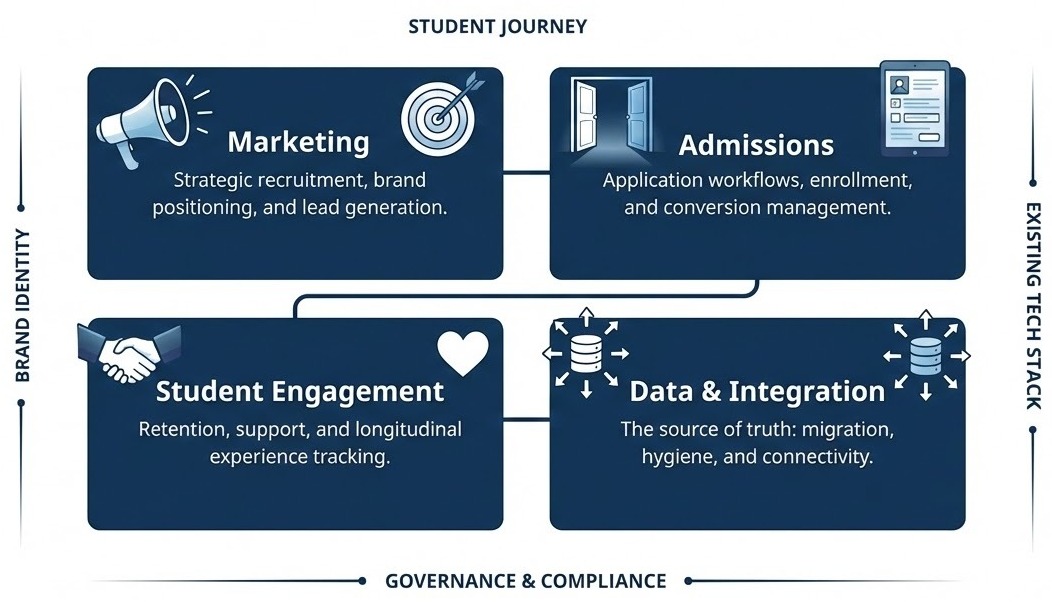
So the previous categories of CRMs focussed the implementation on the regulatory and IT compliance first, the student journey after that, and rarely included the brand and purpose (beyond a bit of styling).
We start with the Student journey, and ensure regulatory and IT compliance in that context, but how do we do with HubSpot to bring your brand and purpose into compliance, specifically?
Introducing the Loop
HubSpot have redefined the way that their entire platform will drive customer engagement now, in the AI era. It’s no longer a linear path, but an infinite loop.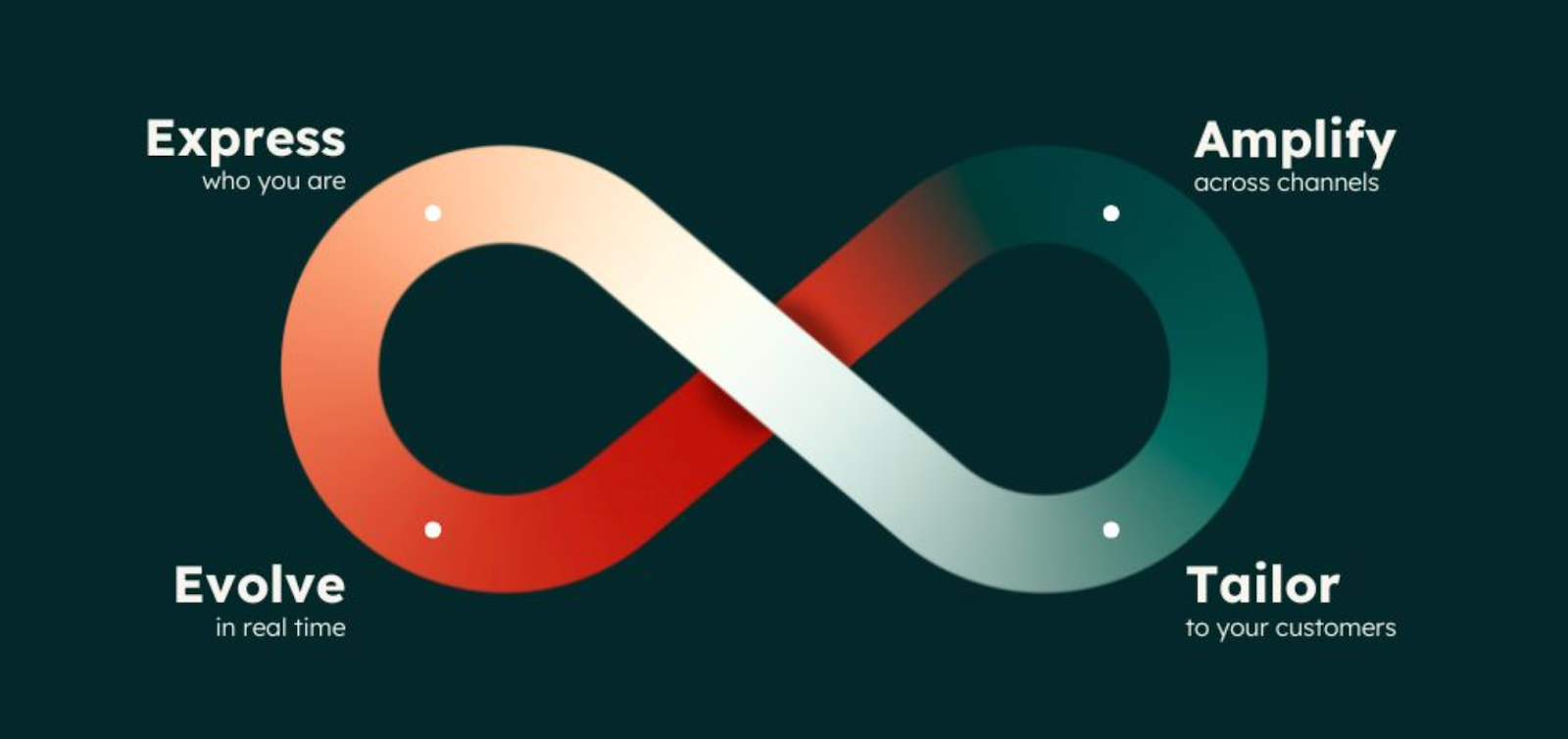
In Universities, the stages look like this:
- Express: What is your purpose? How do you make that land properly with each student? Is it the impact your students make on the world in the future, your location, your status, your place in the world, your academic specialism? However you see it, you need to express it clearly in terms of how your students want to engage with you. We help you refine this with persona and journey mapping, build it into the HubSpot tools and track how it lands so you can continue to improve it.
- Tailor: Not just personalisation (e.g, Hello [First Name]), but 1:1 personal messaging at scale. Not just email, but whatever channel they want to engage on. Not just the website and SEO, but in the LLMs with AEO. Automation that responds with context and provides the next steps, from first touch, all the way through their time with you and out into the world after.
- Amplify: See what works, on what channel, and when - do more of that. What doesn’t land, optimise or stop. Reduce noise and waste, boost conversions. We connect all of your channels in HubSpot, track attribution, and train your team to spot the opportunities to boost your signal. Easily identify and compare your touch points across channels for any factor you can think of - by course, intake, geo, demographics, star sign (only joking, just checking you were still paying attention).
- Evolve: Universities have a huge advantage here, your ‘customers’ don’t ghost you as soon as they buy - they stick around and challenge you for years. Capturing the voice of the Student in the CRM gives you enormous insight into how you can refine your purpose, tailor your messages and amplify your impact. We connect your feedback channels including chat, forms, calls and surveys, route tasks to the right people, manage SLAs, help you resolve more queries at tier 1 and tier 2, minimise admin, and speed up responses to boost student engagement and satisfaction scores.
The procurement advantage
For institutions navigating public sector procurement requirements, BabelQuest is the only HubSpot partner vetted by the Crown Commercial Service and approved on the G-Cloud framework. This isn't a minor administrative detail, it's a practical accelerator that removes weeks or months from the procurement timeline and significantly reduces the internal resource required to begin a transformation programme.
What we'd recommend
We're not suggesting HubSpot is the right choice for every institution. We are suggesting that any university conducting a serious CRM evaluation in 2026 that excludes HubSpot from its shortlist is missing out - you may be making that decision based on outdated assumptions about the platform's capability and sector fit.
The evidence from BabelQuest’s university implementations demonstrates that HubSpot, implemented by a partner with deep HE domain expertise, delivers measurable outcomes on the metrics that matter: faster time-to-value, dramatically reduced administrative burden, and critically, the user adoption that determines whether any CRM investment succeeds or fails.
If you're currently evaluating CRM platforms, or if you're one of the 61% considering what comes next after a failed implementation, we'd welcome the conversation.
Transforming Further Education




.png?width=50)

%20(1).jpg?width=50)
.png?width=50)

.png?width=50)
.png?width=50)


